How to Read a Slave Schedule: Finding Your Ancestors in the 1850 and 1860 Census
If you are researching African American family history, you need to know what slave schedules are and what they are not. These records can help you identify an enslaver, narrow a location, and strengthen a theory about a family before Emancipation. They cannot name your enslaved ancestor. That part matters.
Too many beginners either skip these records completely or expect them to do something they were never designed to do. Slave schedules are tools. Useful tools. But only when you use them with the 1870 census, probate, tax, deed, estate, and Freedmen’s Bureau records. Start there.
1. What slave schedules actually show
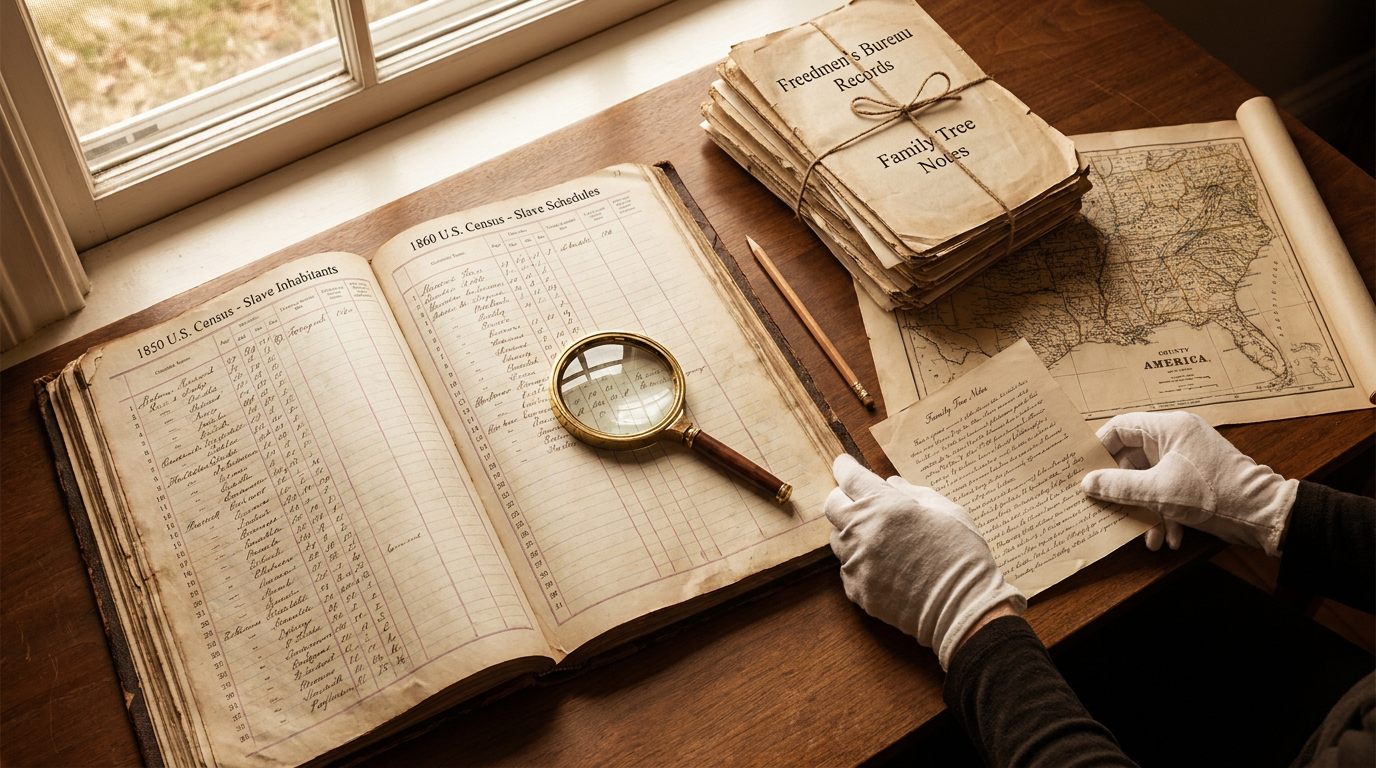
The federal government created slave schedules as part of the 1850 and 1860 census. These schedules listed enslavers by name and counted the enslaved people they held. Instead of listing the names of the enslaved, the schedules usually recorded each person by age, sex, and color. You may also see notes about whether a person was a fugitive, manumitted, deaf, blind, insane, or idiotic, along with the number of slave houses on the property.
Read that again: the enslaved person is not named.
That is why this record must never stand alone. A slave schedule can suggest that an enslaver in a specific county held an enslaved Black female age 12 in 1860, or an enslaved Black male age 35 in 1850. That matters when you are trying to place a family in a time and place before 1870. But it is still indirect evidence. You have to build the case.
You can usually find these schedules on the major genealogy websites that host U.S. census records, and on microfilm through large libraries and archives. Search by county and enslaver name, not by the name of your ancestor. The record was not created to honor the people in bondage. It was created to inventory them. Harsh truth. Still a record worth using.
2. How to work backward from 1870
The real work starts in 1870 because that is the first federal census after slavery where formerly enslaved people appear by name in most cases. Find your ancestor there first. Do not skip ahead because you are excited to get into slavery-era records. If your 1870 identification is weak, everything after that gets weaker.
Start with these steps:
- Find the family in the 1870 census and document every detail: names, ages, birthplace, occupation, household members, neighbors, and county.
- Study the people living nearby. Pay attention to white households with the same surname your family used in 1870. That is not proof of an enslaver relationship, but it is a clue you should test.
- Check the 1880 census, marriage records, death records, and the death certificates of the children and grandchildren. Surnames shift. Ages shift. Places do too. Keep building the cluster.
- Look for Freedmen’s Bureau labor contracts, marriage records, rations records, complaints, and school records in the same county or nearby counties.
- Search Freedman’s Bank records if your ancestor lived near a branch and likely interacted with the bank. Those records can name parents, siblings, spouses, and former enslavers.
- Once you have a strong candidate for the enslaver family, go back to the 1860 and 1850 slave schedules for that county.
Now compare what you know. If your ancestor was about 22 years old in 1870, that person would have been about 12 in 1860 and about 2 in 1850. Look for age patterns inside the probable enslaver’s household. Then compare that pattern against probate inventories, wills, estate divisions, deeds, and tax lists. That is how you go from possibility to proof.
3. What these records can help you prove, and where people go wrong
A slave schedule can help you answer questions like these: Was a likely enslaver in the right county at the right time? Did that person hold enslaved people whose ages and sex line up with the family you found in 1870? Did the number of enslaved children suggest family groups? Did the enslaver own enough land or leave enough probate material to generate more records?
What it cannot do is tell you, by itself, that the 14-year-old Black female on the 1860 slave schedule was your ancestor Sarah. It might be. It might not. Say that plainly in your notes.
This is where researchers get careless. They find a same-surname white family in 1870, jump to the 1860 slave schedule, and decide they found the answer. That is not genealogy. That is guessing.
Here are three mistakes to avoid:
- Treating same surname as proof. Many freed people kept a former enslaver’s surname. Many did not. Some used a surname from an earlier enslaver, a father, a stepfather, or a choice made after freedom.
- Ignoring county lines. Your family may have crossed into the next county after emancipation, after sale, or after the war. Search the surrounding counties.
- Using ages too rigidly. Ages in census and slavery-era records can be off by several years. Look for patterns, not exact perfection.
When slave schedules are paired with probate and estate records, they become much more powerful. An estate inventory may list named enslaved people. A division of property may separate mothers from children on paper. A will may free someone, sell someone, or transfer a family group to heirs. Painful records. Necessary records. This is often where descendants begin to see their people come back into view.
Conclusion and next step
Slave schedules are not miracle records, but they are not useless either. They help you place enslaved ancestors inside a specific county, time period, and probable enslaver household. Used the right way, they can move your research forward.
If you are stuck on the jump from 1870 into slavery, do not keep spinning your wheels alone. Book a coaching session with me and we will map out your moves, and build a research plan you can actually use this week.